Mental Health in Development
A family of research websites sharing a common design language — built to meet NIHR standards while giving each project its own distinct voice and audience.

Logos matter. For MHID, we developed a recognisable design scheme which can be adapted for multiple projects, making each flexible but distinctive within the MHID family.
The Challenge
The Mental Health in Development (MHID) programme, funded by the National Institute for Health and Care Research (NIHR), is not a single project — it is a constellation of them. Each sits under the same umbrella but speaks to a very different audience.
- The AnDY Research Clinic Oxford serves clinicians and families navigating NHS assessment and treatment
- OPEN-ARMS is an NHS support service for people in Oxfordshire aged 14-35 who are having “Unusual Experiences”
- Supporting Early Minds works with schools, early years practitioners and parents of young children
- The WISDOM Research Network connects researchers with schools
- INSiGHTS focuses on innovative methods for involving young people in research
- Adaptive Innovative Methods brings together thinking on mechanisms and measures of youth mental health
- The Parent Carer Research Network amplifies the voices of parents and carers across the research community.
Building a separate, standalone website for each project would have been wasteful and inconsistent. Yet simply publishing everything under one roof risked drowning each audience in content that wasn’t meant for them.
The design challenge was therefore twofold: create a visual identity that clearly signals NIHR affiliation and meets its branding requirements — and then find a way to flex that identity so each subsite feels tailored to the people it is trying to reach, while remaining unmistakably part of the same family.
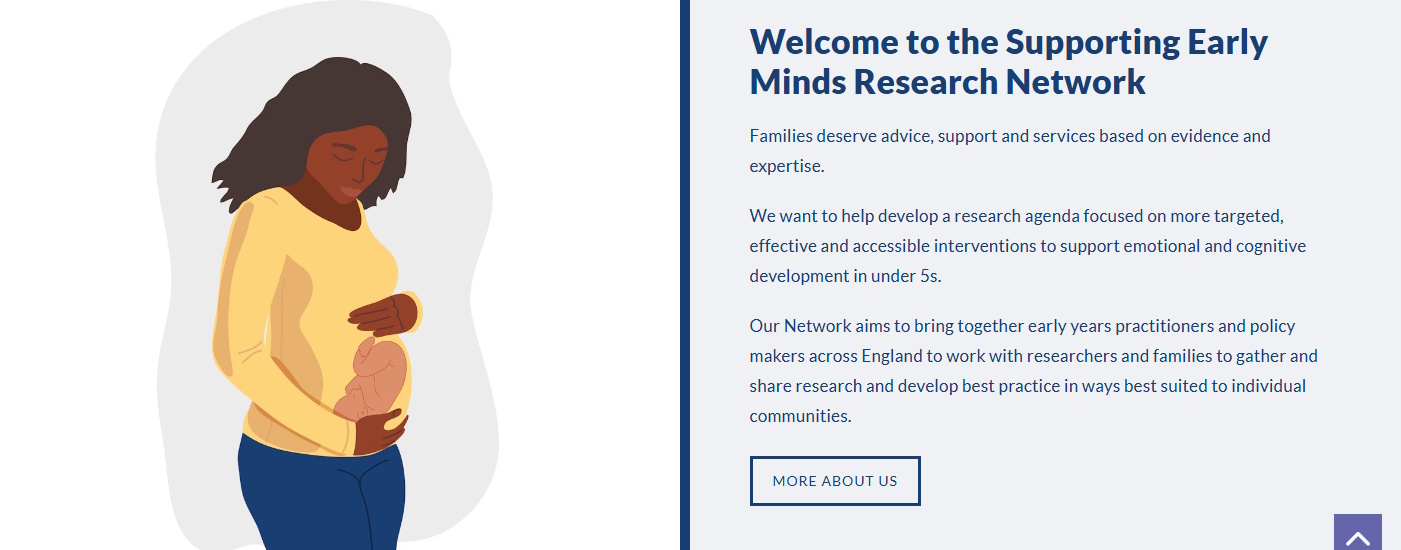
The MHID research projects aim to improve mental health care in young people, ranging from early years, right through to adulthood.
The Solution
We began where we always begin: with the people who would actually use the sites. Working alongside the MHiD team, we ran collaborative design sessions that drew on the knowledge and priorities of researchers, clinicians, young people, parents and carers. This user involvement shaped the design from the ground up, rather than being bolted on at the end.
From those conversations, we developed a professional, considered design theme that satisfies NIHR’s visual requirements while giving the programme a distinctive identity of its own. Crucially, the theme was built to be adapted rather than just copied: each subsite inherits the shared typographic and colour framework, then diverges in palette, imagery and tone to suit its specific audience — warm and accessible for parent-facing content, authoritative and clinical where researchers are the primary readers.
Under the hood, we used WordPress Multisite — a mature, open-source content management system — to run the full family of subsites from a single installation. Shared code means shared quality: a design improvement or security update applied once flows through to every site simultaneously. Yet each editorial team retains full autonomy over their own content, navigation and structure.
We were also careful not to simply hand over a finished product and disappear. Working closely with the MHiD team, we provided expert support across the full content lifecycle — advising on information architecture, helping to shape and structure content for each audience, and editing copy to ensure it was clear, credible and appropriately pitched whether the reader was a parent, a clinician or a policy-maker.
The result is a network of sites that feels coherent from the outside and purposeful from the inside — a platform that can grow as the programme grows, with new subsites joining the family without starting from scratch.